What this service covers
New construction, system replacement, or property subdivision installs. Every install runs through the Delaware Public Health District or Licking County Health Department permit process, with conventional or alternative system designs for lots that pose perc test challenges.
Typical pricing
$8,000-$25,000
Pricing varies by job specifics. Free phone or on-site quotes; fixed pricing once the technician has assessed the job.
Conventional gravity, mound, drip, and aerobic Columbus installs
Central Ohio lots vary widely in soil percolation, water table depth, slope, and lot size, so the right system for a given home depends on a perc test, soil-evaluation report, and county HSTS permit review. Four system types cover almost every Greater Columbus scenario.
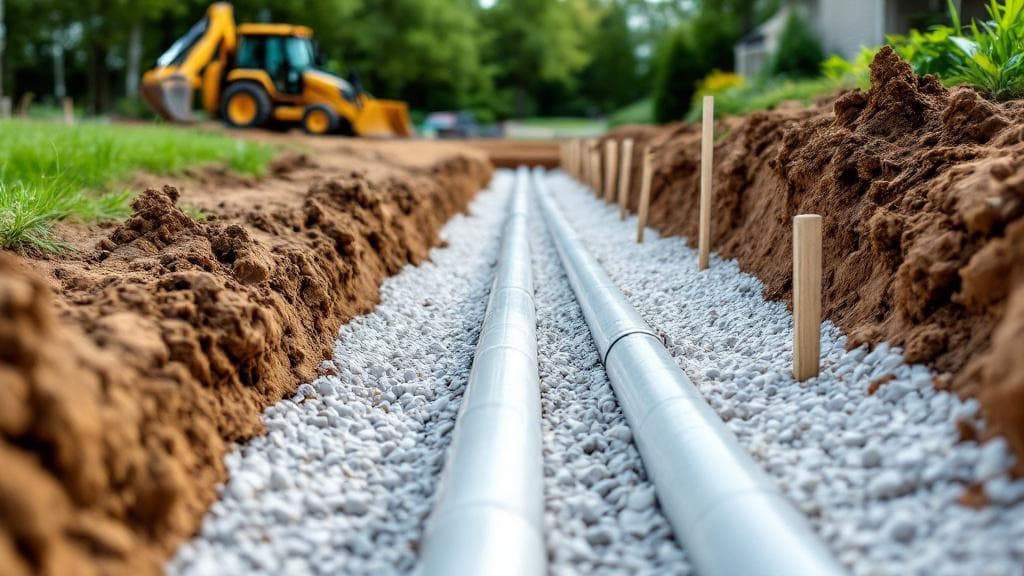
Conventional gravity drain field systems are the lowest-cost option ($8,000-$15,000) and work on flat-to-gently-sloped lots with good percolation (perc rate 30-90 minutes per inch). The system uses a 1,000-1,500 gallon two-compartment concrete tank, a distribution box (D-box), and 200-500 feet of perforated 4-inch PVC laterals laid in clean drain rock 12-18 inches below grade. Gravity moves effluent from tank to D-box to laterals; soil bacteria treat the effluent in the biomat at the gravel-soil interface.
Mound systems ($14,000-$22,000) are required when the perc rate is too slow (greater than 90 minutes per inch), the water table is too high (within 24 inches of grade), or shallow bedrock blocks conventional drain field excavation. The mound is a sand-and-gravel built-up structure 18-30 inches above grade with a pressure-distribution manifold; effluent is pumped into the mound and treated as it percolates down through the engineered media. Common in rural Licking County and the flat-bottom areas of Pickaway County.
Aerobic treatment units (ATUs, $12,000-$18,000 for the unit plus drain field) use forced-air aeration to accelerate effluent treatment, producing higher-quality effluent than conventional anaerobic tanks. Required for surface-discharge permits under Ohio EPA NPDES OHK000004 and for sites where soil treatment is impractical. Drip irrigation systems ($15,000-$25,000) are pressure-distributed shallow-buried laterals that work on small or oddly-shaped lots and on sites with shallow bedrock; less common in Central Ohio but a strong option for tight Delaware County and Union County lots.
Columbus HSTS permit timeline and county-by-county requirements
New septic system installs in Greater Columbus require a Household Sewage Treatment System (HSTS) permit from the relevant county health district before any digging happens. The typical timeline runs 30-60 days from soil evaluation to permit-in-hand to installation start, depending on county workload and any soil-condition complications.
The standard permit sequence: (1) site evaluation by a registered soil scientist or qualified inspector who logs soil profile, restricting layers, water table, and slope; (2) perc test if conventional drain field is being considered; (3) system design submitted by the licensed installer with the relevant county form (Delaware Public Health District, Licking County Health Department, and Fairfield Department of Health each have their own application packet); (4) county review and approval, typically 14-30 calendar days; (5) installation under permit, with a county inspector required on-site for the bedding inspection and final inspection.
Columbus specific: pre-1980 systems in rural Delaware County and rural Licking County sometimes lack any county records of the original install, which complicates replacement permits because the county wants documentation of the existing system before approving a new design. Undocumented-system issues are resolved directly with the relevant health district as part of the permit work; in practice this adds 2-4 weeks to the timeline but rarely blocks the project. All Central Ohio permits run through the local county health district under Ohio Administrative Code 3701-29, so the protocol is consistent across Delaware, Licking, Fairfield, Union, Madison, and Pickaway counties even though each office has its own queue.
Signs your Columbus septic system needs full replacement, not repair
Central Ohio septic systems typically last 25-50 years with proper maintenance. Replacement-driving failures fall into a few categories. Drain field saturation (effluent surfacing on the lawn, soggy ground above the drain field, sewage smell outside) usually means the soil treatment capacity is exhausted; this is the most common Columbus replacement trigger and accounts for roughly 60 percent of full-replacement quotes across Greater Columbus. Tank structural failure (cracked concrete, collapsed inlet/outlet baffles beyond repair, tank floating from groundwater pressure) is less common but warrants tank replacement; the drain field can sometimes be preserved.
Hydraulic overload from household-size growth (a 3-bedroom home with a 1,000-gallon tank that becomes a 5-bedroom home through additions) often warrants tank-and-field upsize because the original system was sized for the smaller load. This is common in Lewis Center and Powell homes where additions added bedrooms over the years. Whether upsize is sufficient or full replacement is required depends on current condition and county code.
Repair-versus-replace economics: a typical full-replacement install runs $12,000-$22,000. A drain-field-only replacement runs $6,000-$12,000 if the tank is sound. A tank-only replacement runs $4,000-$8,000 if the field is sound. Repair work (baffle replacement, distribution box re-leveling, riser install) runs $400-$3,500. We quote both repair and replacement options when both are technically viable so the homeowner sees the trade-off; the right choice depends on system age, expected ownership horizon, and whether the homeowner wants to defer the larger spend.
Service area
New Septic System Installation is available across Greater Columbus and Central Ohio. Per-suburb pages: